





|
Tapfresh.com |
|
Bottled water at your faucet |

|
Question: What makes RO filtration superior to other water purifying methods?
Answer: “zero channeling”. As we mentioned earlier, “channeling” is the escape or passage of unfiltered water in standard carbon filtration. Though carbon filtration is still an excellent process to filter water it isn’t perfection.
Question: What happens to the contaminants that are filtered out or blocked?
Answer: The reverse osmosis process cannot go on indefinitely without a contaminant build up from the supply water. Ultimately, the membrane would clog by salts and other impurities, requiring increasingly greater pressure to force water through the membrane. To solve this problem, the membranes are configured to split the feed water into two streams -- one part to be purified and the other part to wash away the particles rejected by the membrane.
Q. WHAT IS THE STEP BY STEP PROCESS OF AN RO SYSTEM?
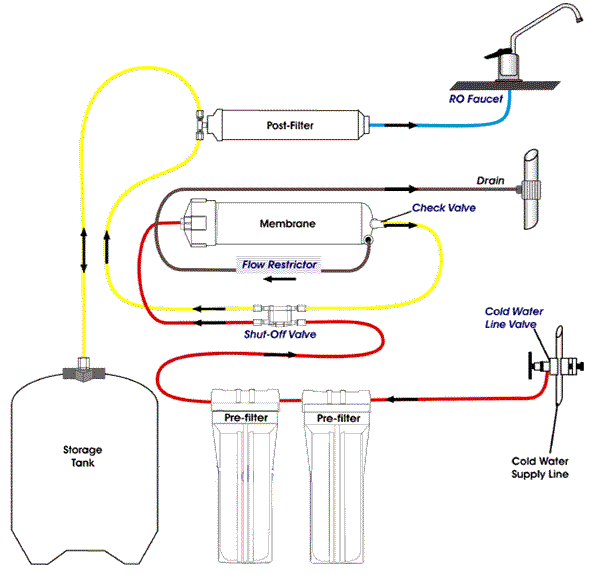
Refer to the diagram below: |
|
Reverse Osmosis |
|
Question: What is the best approach in water purification?
Answer: Reverse Osmosis
Question. What is Reverse Osmosis?
Reverse Osmosis (RO) is the reversal of the natural flow of osmosis. Huh? Sorry, click here: Reverse Osmosis
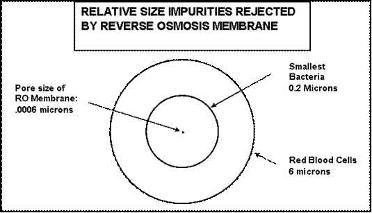
In short, the reverse osmosis process goal is to separate the water molecule from other unwanted molecules. This is done using an RO membrane filter. The membrane is a plastic tube layered with special composite films that are bonded together in a spiral configuration. The end product is a filter whose .0006 micron (or pore size) count is so small that most molecules cannot pass through. But luckily for us, H2O can.
Referring to the following diagram, notice the size ratios representing a water molecule compared to the smallest bacteria known to man, and or to a mammal red blood cell. Fortunately, the water molecule is truly that small. |

|
ANSWER: In this diagram above, raw tap water flows though a 5 micron SEDIMENT or Pre-FILTER to remove dirt, rust and other sediment. The water then flows through a 10 micron CARBON FILTER that reduces chlorine and other chemicals. Then that water proceeds to the membrane filter where in the filter housing, water is split into two paths, A and B.
Path A: Water flows through the membrane where only the water molecule can pass. From there, RO pure water fills a pressurized reservoir storage tank to compensate for demand during use. This process takes much time due to the low flow rate of a RO membrane that is measured in GPD (gallons per day). For that reason, a 3 gallon pressurized tank is required.
Path B: At the input of the RO membrane, an accumulation of unwanted impurities builds up over time. This water is allowed to escape through a flow restrictor that offers just enough back pressure so the reservoir can fill while allowing gray water to pass to the drain. Finally when the tank offers a desired back pressure, the Automatic Shut-Off Valve (ASO), cuts the water supply to the membrane, which lowers water loss. And when the Automatic Shut-off Valve (ASO), senses the loss of pressure in the tank, it re-engages the water supply across the membrane and the process starts over.
The 5-stage of the process is a small carbon POST FILTER that removes any remaining trace elements that may come from the tank. Another purpose is said to soften the taste from the virtually distilled like water but I disagree with that analysis because an effective RO system removes all that’s in water that offers taste. Not to be alarmed because you quickly adapt to this water because you are not use to it. You are use to your water having taste. However, after drinking this water, you will not only learn to enjoy it, you will prefer it because it is so clean.
|